How Hair Growth Works
Daily Health & Beauty
Hair Loss Hub
How Hair Grows, Rests, And Renews
Your follicles do not all grow and rest together. Understanding the hair cycle helps explain normal shedding, gradual thinning, and why different changes in your hair can need different responses.
Explore The Hair Loss Hub →Meet The Hair Follicle
Hair grows from follicles within the skin. Growth begins at the root, where the dermal papilla supplies blood and nutrients that support the growing hair. The follicle is the structure beneath the surface, not just the strand you can see.[1]
DermNet describes a healthy scalp as having around 100,000 follicles. These follicles cycle at different times, rather than moving together through a single whole-scalp growth or resting phase.[2][3]
Shedding is part of the normal cycle. The AAD describes about 50 to 100 shed hairs a day as normal. Increased shedding and progressive thinning are different questions, even though they may both make you notice more hair changes.[4]
Growth, Transition, Rest
The Three Main Phases Of The Hair Cycle
These ranges describe normal scalp-hair biology, not a timetable for treatment results. Duration varies, and different medical references describe slightly different ranges.
Anagen
The Growing Phase
During anagen, the follicle actively produces a growing hair. Cleveland Clinic describes this phase as lasting about two to seven years. DermNet estimates that roughly 85–90% of hairs on a healthy scalp are in anagen at a given time.[1][3]
Scalp hair can grow long because this phase lasts much longer than the growth phase of shorter hairs such as eyelashes. The duration of anagen helps determine hair length.[2]
Catagen
The Transition Phase
This is the short transition between active growth and rest. Growth stops and the follicle shrinks. DermNet describes catagen as lasting about two to three weeks and involving roughly 1–3% of hairs at a time.[2]
A follicle moving through catagen is not, by itself, evidence that you are developing pattern hair loss.
Telogen
The Resting Phase
The follicle rests rather than actively lengthening a hair. DermNet describes this phase as lasting about one to four months. The hair can then be released as the cycle continues; Cleveland Clinic includes shedding within its description of the inactive phase.[2][1]
Resting and shedding are normal parts of hair renewal. The question is whether the amount, pattern, or timing of change suggests something beyond your usual cycle.
Cleveland Clinic describes hair growing about one centimeter per month. That is a general growth-rate reference, not a prediction of how much density a treatment will restore or how quickly you will see a fuller-looking scalp.[1]
What Changes With Pattern Hair Loss?
MedlinePlus explains that androgen stimulation can shorten the growing period, producing shorter, thinner hairs and delaying replacement of hairs that have been shed. These changes contribute to thinning in androgenetic alopecia.[5]
DHT is involved particularly in male pattern hair loss. Androgens also play a role in female pattern hair loss, but other incompletely understood factors are involved. It is too simple to explain every woman’s thinning, or every form of hair loss, as a DHT problem.[5]
For more detail, read DHT And Hair Loss and Hair Loss In Women.
Why Increased Shedding Can Look Different
Having follicles on different schedules does not mean all hair loss must be gradual. Illness, childbirth, surgery, significant weight loss, or major stress can be followed by excessive shedding, called telogen effluvium. It often becomes noticeable a few months after the event.[4]
The AAD explains that shedding can settle as the body readjusts, with fullness tending to return over several months. A continuing stressor can prolong shedding. That pattern is different from assuming that every shed hair represents ongoing hereditary miniaturization.[4]
A widening part, noticeable thinning, a new patch, increased shedding, or scalp symptoms can be useful reasons to seek an assessment. You do not need to estimate a percentage of density loss before asking for help.
Explore the broader possibilities in Why Is My Hair Falling Out?
The Cycle Is Only Part Of The Picture
Thyroid disease, inadequate nutrients, some medicines, and other conditions can contribute to hair loss. These are reasons to understand the cause, not to assume that every change needs a stronger serum, more scalp massage, or an added supplement.[6]
- Consider The Timing. Note when the change began and whether it followed an illness, childbirth, a medication change, or another event.
- Describe What You See. Gradual thinning, sudden shedding, patchy loss, and scalp discomfort are different observations to bring to an appointment.
- Match Care To The Cause. Treating a diagnosed thyroid problem or a confirmed deficiency is not the same as choosing a cosmetic product.
- Ask Before Changing Medicines. Discuss a suspected medication effect with the prescriber rather than stopping it yourself.[6]
What Does The Biology Mean For Treatment?
Minoxidil can help some people with pattern hair loss, but it does not work for everyone. The AAD describes results usually taking about six to twelve months, with continued use needed to maintain benefits if it helps. This is a minoxidil reference point, not the duration of a normal hair cycle or a universal timeline for all treatments.[7]
Follow the exact product’s instructions about who should use it, application, warnings, and when to seek advice. Those instructions take priority over a general timeline, including when they call for an earlier review.
Cosmetic shampoos, conditioners, and serums have their own intended uses. A conditioning or fuller-looking-hair claim should not be treated as proof of medicinal regrowth. Likewise, ordinary scalp care does not establish that another product will reach the follicle more effectively or work better in combination.
For practical next steps, read Minoxidil For Hair Loss and the Hair Loss Treatment Timeline.
Hair Loss Products
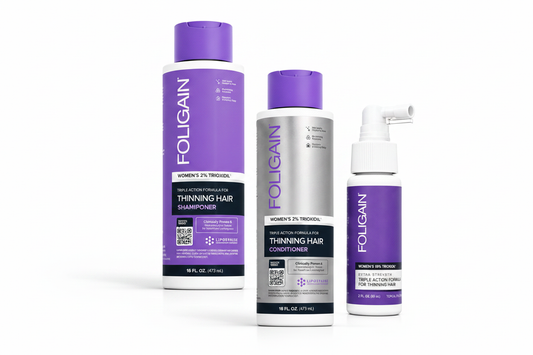
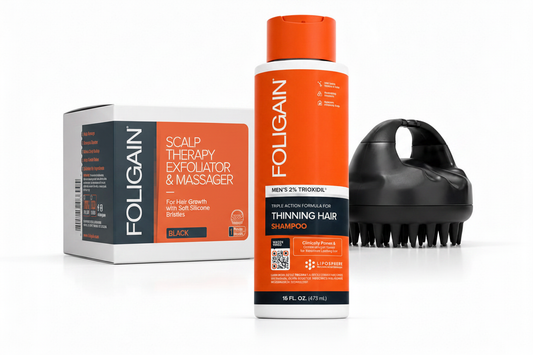
Explore Men’s And Women’s Minoxidil, Compare Cosmetic Hair Care, Or Choose A DH&B Curated Bundle. Each Product Has Its Own Directions—Choose The Options That Fit Your Needs.
← Scroll Horizontally To Explore More Products →
Further Reading
Continue Exploring Hair Loss
Explore The Hair Loss Hub And Five Related Guides On Hair Growth, Minoxidil, And More.
Explore The Hair Loss Hub →DHT And Hair Loss
Learn About DHT And Its Role In Pattern Hair Loss.
Read The Guide → CausesWhy Is My Hair Falling Out?
Explore Common Causes And Factors That Can Affect Hair And Scalp.
Read The Guide → MinoxidilMinoxidil For Hair Loss
Explore Our Guide To Minoxidil, Its Use, And What To Consider.
Read The Guide → For WomenHair Loss In Women
Read About Female Hair Loss, Common Patterns, And Contributing Factors.
Read The Guide → TimelineHair Loss Treatment Timeline
Explore Treatment Timelines And Questions To Discuss With Your Healthcare Provider.
Read The Guide →Sources & Further Reading
- Cleveland Clinic: Hair Follicles And The Growth Cycle
- DermNet: Hair Loss And The Hair Growth Cycle
- DermNet: Hair Shedding
- AAD: Hair Loss And Hair Shedding
- MedlinePlus Genetics: Androgenetic Alopecia
- AAD: Causes Of Hair Loss
- AAD: Hair Loss Diagnosis And Treatment
These medical references support the educational information, not an endorsement of the products offered here. Product-specific facts and instructions appear on the individual product pages.
This article is for informational purposes only and does not constitute medical advice. Consult a licensed healthcare professional for diagnosis and treatment of hair loss conditions.