Why Is My Hair Falling Out?
Daily Health & Beauty
Hair Loss Hub
Understanding Why Hair Falls Out
More hair in the shower, a widening part, or a new patch can raise different questions. Use this guide to recognize useful clues, understand common explanations, and decide which next step makes sense without trying to diagnose the cause from one sign alone.
Explore The Hair Loss Hub →Some Shedding Is Normal. A Change Still Deserves Attention.
The American Academy of Dermatology describes about 50 to 100 shed hairs a day as normal. Shedding is part of the hair cycle, but a noticeable increase, less fullness, or a new pattern of loss can be worth discussing even if you have not counted the hairs.[1]
A receding hairline, widening part, thinner ponytail, patchy loss, and scalp discomfort are different observations. They help describe what is happening; they do not establish the cause on their own.[5]
Understanding The Cause Can Help You Decide What To Do Next.
Photos taken under similar conditions can be a useful record. They are not an infallible test, and changes in lighting, parting, styling, or wetness can affect how full your hair looks.
Common Explanations And Useful Clues
Why Hair May Be Shedding, Thinning, Or Breaking
Hereditary Or Pattern Hair Loss
The AAD estimates that hereditary hair loss affects 80 million Americans, including 50 million men and 30 million women. Those figures refer to hereditary thinning, not every cause of hair loss.[7]
Men often notice a receding hairline or thinning crown, while women may notice a widening part and thinning across the top. Androgens, including DHT, are involved particularly in male pattern loss; female pattern loss has additional factors that are not fully understood.[3]
Shedding After Illness, Childbirth, Or Stress
Excessive shedding, known as telogen effluvium, can follow events such as illness, surgery, childbirth, significant weight loss, or major stress. It often becomes noticeable a few months after the event, so the timing can feel unexpected.[1]
The AAD explains that shedding can settle as the body readjusts, with fullness tending to return over several months. Ongoing stress can prolong the shedding. This is not the same as assuming every shed hair represents hereditary miniaturization.[1]
Hormonal Changes And Life Stages
Childbirth and stopping some birth-control pills can be followed by increased shedding. Hormonal imbalances can also contribute to thinning. These are useful parts of your history, not proof that every life-stage change is caused by DHT or needs the same topical routine.[1][2]
Read Hair Loss In Women for more context on pattern thinning, postpartum shedding, and menopause.
Health Conditions Or Medication Effects
Thyroid disease and some medicines can contribute to hair loss. Treating the diagnosed condition or reviewing a medicine with its prescriber is different from simply adding another hair product. Do not stop a prescribed medicine because you suspect it affects your hair without speaking to the prescriber.[2]
Not Getting Enough Certain Nutrients
Inadequate iron, protein, zinc, or biotin can contribute to hair loss. That does not mean everyone with shedding needs supplements. The AAD advises taking biotin, iron, or zinc supplements for hair loss only when testing shows a deficiency; excessive amounts can be harmful.[2][6]
Patchy Loss Or Scalp Conditions
Patchy loss has more than one possible explanation. Alopecia areata often begins as a smooth round or oval patch, while scalp infections can produce scaling, inflammation, or broken-hair stubs. Appearance alone is not enough to tell these apart reliably.[9][2]
Burning, tenderness, intense itching, scaling, sores, or other scalp symptoms are reasons for assessment rather than assuming the answer is more exfoliation or a cosmetic serum.[5]
Repeated Pulling From Hairstyles
Repeated tension from tight braids, ponytails, buns, extensions, or similar styles can cause traction alopecia. Continuing the pulling can lead to permanent hair loss. Pay attention to styles that hurt or feel too tight, and seek advice about changes at the hairline or areas under tension.[4]
Hair Breakage And Styling Damage
Excessive heat and damaging styling habits can weaken or break hair. Breakage is not identical to a whole hair shedding from its follicle, and it should not be grouped automatically with hereditary thinning or traction alopecia. Reviewing hair-care practices can be part of understanding what you see.[8]
What To Bring To An Assessment
A dermatologist begins with questions, a scalp examination, and an assessment of the hair. Blood tests or a scalp biopsy may be appropriate when a disease, deficiency, hormonal issue, or infection is suspected. There is no single blood-test panel that this guide recommends for everyone.[6]
- When Did It Begin? Note whether the change was gradual or sudden, and what happened in the months before you noticed it.
- Where Is It Happening? Describe the hairline, part, crown, patches, or more widespread shedding rather than choosing a diagnosis yourself.
- What Else Changed? Include recent illness, childbirth, major stress, diet changes, medicines, supplements, and hairstyles.
- Are There Other Symptoms? Mention scalp pain, burning, itching, scaling, sores, or changes elsewhere on the body.
- What Have You Already Tried? Bring the product names and directions, when you started them, and any reactions or changes you noticed.
Family history and photographs can add context, but neither is a diagnosis by itself. A good record helps make the conversation more useful.
Choose The Next Step For The Problem
For suspected pattern thinning: Discuss the cause and relevant treatment options rather than assuming every cosmetic product will stop the underlying process. Minoxidil is an option for some people with pattern hair loss, but it is not suitable for every cause or a guaranteed result.[6]
For increased shedding after an event: The trigger and recovery pattern matter. Improvement can occur as the body readjusts, so recovery does not automatically show that a shampoo, serum, or supplement caused regrowth.[1]
For sudden, patchy, painful, or unexplained changes: Seek an assessment rather than waiting through an assumed product-results timeline. Scalp symptoms and the pattern of loss can help identify conditions that need different care.[5][6]
For deeper reading, explore How Hair Growth Works, DHT And Hair Loss, Minoxidil For Hair Loss, and the Hair Loss Treatment Timeline.
Hair Loss Products
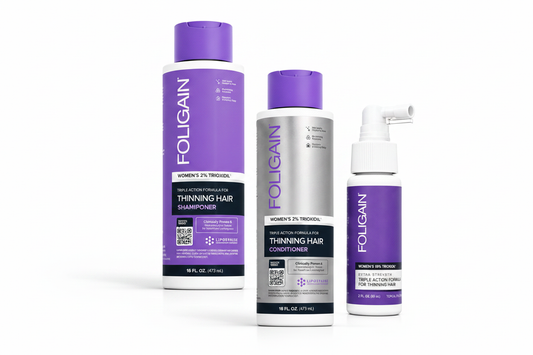
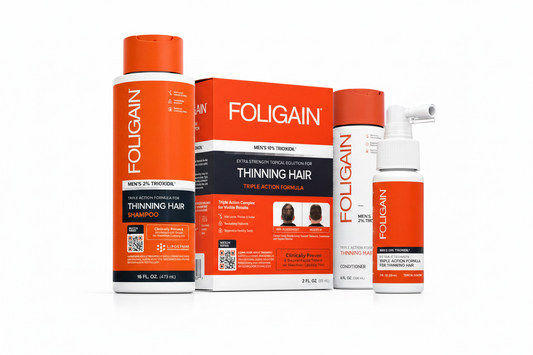
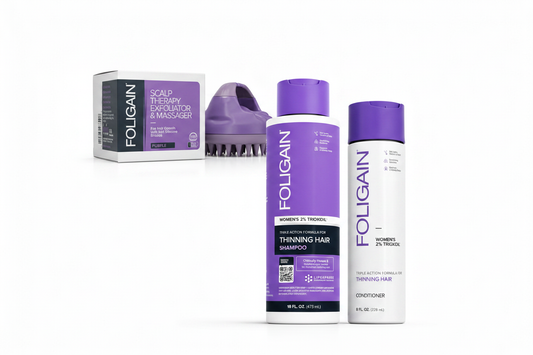
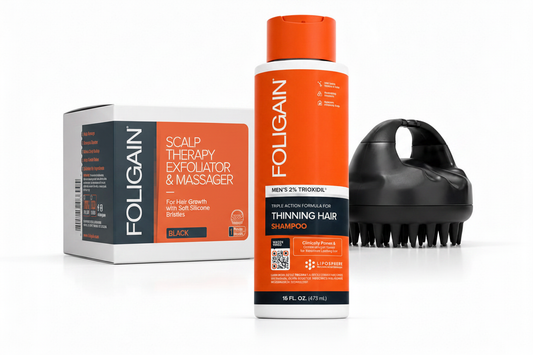
Explore Men’s And Women’s Minoxidil, Compare Cosmetic Hair Care, Or Choose A DH&B Curated Bundle. Each Product Has Its Own Directions—Choose The Options That Fit Your Needs.
← Scroll Horizontally To Explore More Products →
Further Reading
Continue Exploring Hair Loss
Explore The Hair Loss Hub And Five Related Guides On Hair Growth, Minoxidil, And More.
Explore The Hair Loss Hub →DHT And Hair Loss
Learn About DHT And Its Role In Pattern Hair Loss.
Read The Guide → ScienceHow Hair Growth Works
Get To Know The Hair Follicle And The Hair Growth Cycle.
Read The Guide → MinoxidilMinoxidil For Hair Loss
Explore Our Guide To Minoxidil, Its Use, And What To Consider.
Read The Guide → For WomenHair Loss In Women
Read About Female Hair Loss, Common Patterns, And Contributing Factors.
Read The Guide → TimelineHair Loss Treatment Timeline
Explore Treatment Timelines And Questions To Discuss With Your Healthcare Provider.
Read The Guide →Sources & Further Reading
- AAD: Hair Loss And Hair Shedding
- AAD: Causes Of Hair Loss
- MedlinePlus Genetics: Androgenetic Alopecia
- AAD: Hairstyles And Traction Alopecia
- AAD: Hair Loss Signs And Symptoms
- AAD: Hair Loss Diagnosis And Treatment
- AAD: Hair Loss Statistics
- AAD: Hair Styling Without Damage
- AAD: Alopecia Areata Signs And Symptoms
These medical references support the educational information, not an endorsement of the products offered here. Product-specific facts and instructions appear on the individual product pages.
This article is for informational purposes only and does not constitute medical advice. Consult a licensed healthcare professional for diagnosis and treatment of hair loss conditions.